To embed a form on your website, publish it, copy the code from the Share panel and paste it into your page’s HTML. That part takes a minute. Picking the kind of embed takes more thought, because a contact form on a landing page and a feedback tab in a help center need different things.
Get the embed code
- Build your form and select Publish. Only published forms load for visitors.
- The Share panel opens on its Embed tab. To come back to it later, select Share in the builder’s top bar.
- Under Embed on Your Site, pick a type, such as Inline, Full page or Popup. The floating button and the slider are there too.
- Under Where Is Your Site Built?, pick your site builder to see where the code goes, then select Copy Code.
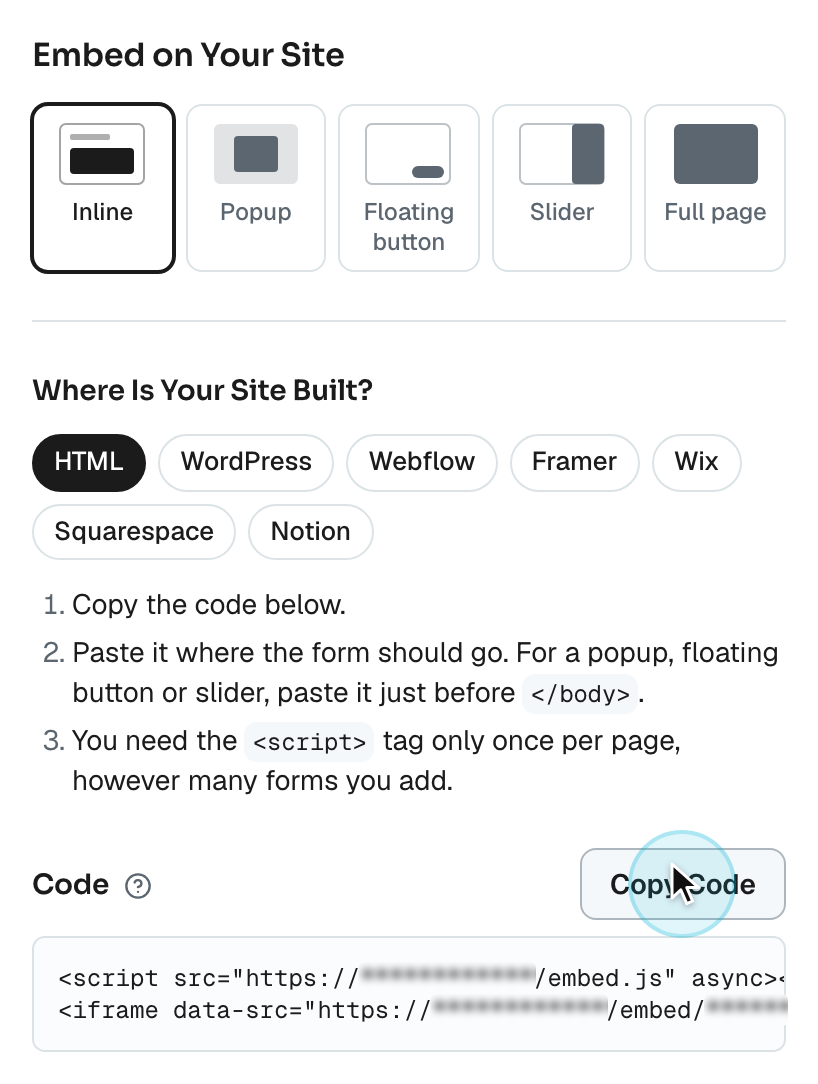
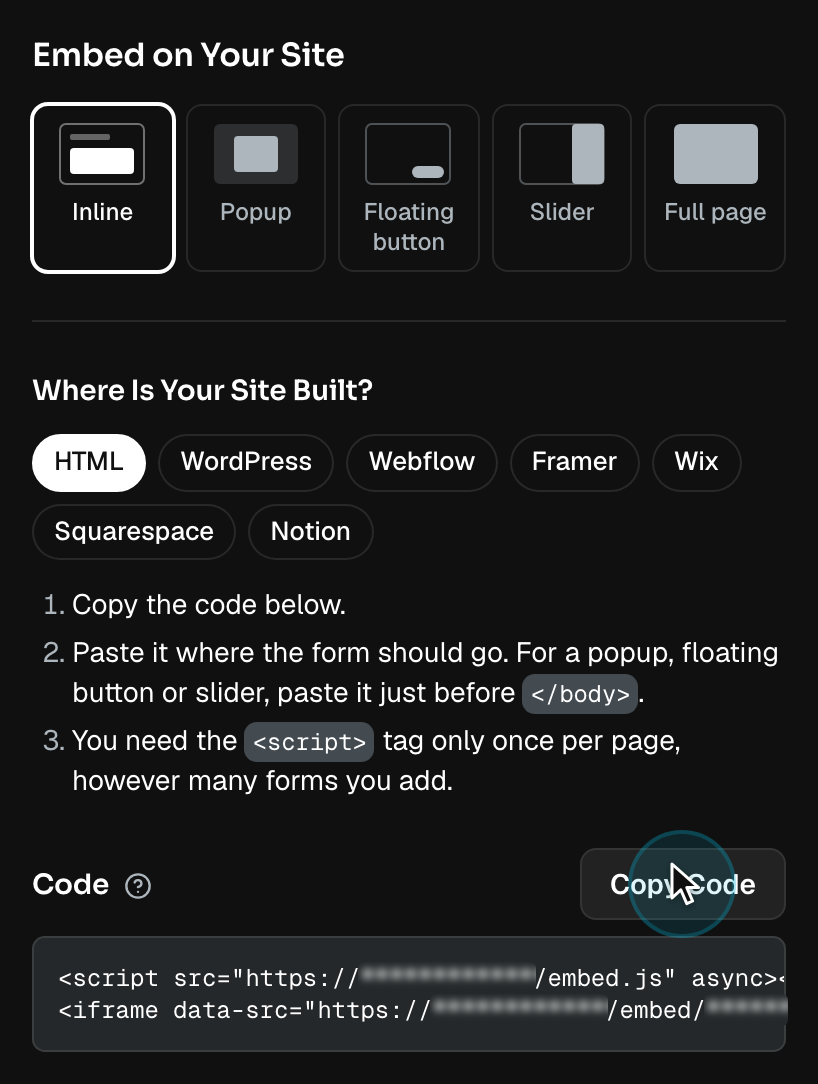
Now open the page in your site’s editor, add an HTML or custom code block where the form should go, and paste the code. A page needs the script only once, however many forms it holds. While the Share panel is open, the builder shows your form on a sample page, so you can try each type before you touch your site.
Pick the embed type for the page
Landing or contact page: inline
When the form is the reason the page exists, put it in the page. An inline embed sits where you paste the code, loads as a visitor scrolls near it, and grows or shrinks to fit its content, so there’s no inner scrollbar and no height to set. To blend it into your design, open Customize and turn off Show Title, or turn on Transparent Background so your page shows through. Both work on every plan. The details are in Embed a Form on a Page.
A page made only for the form: full page
Pick Full page when the form should fill the whole window, for example on an application page with nothing else on it. The frame covers everything else on the page, so keep that page empty apart from the code.
Pricing page: a popup on a button
A pricing page is already busy. A “Request a quote” button that opens the form in a popup keeps it tidy and puts the form one click away. Leave When on On click and type the button’s words into Button Text, up to 60 characters. The popup is 560 pixels wide unless you change it, anywhere from 320 to 800. See Open a Form in a Popup.
Blog post: a popup that opens on its own
A newsletter sign-up on a blog post can open without a click. Under Open the Popup, set When to open it on load, after a delay of up to 120 seconds, once the reader has scrolled part of the way down (40% unless you change it), or when they’re about to leave. Then set How Often, so a reader sees it on every visit, only once, or until they submit it. That way someone who already signed up isn’t asked again on every post.
Every page: a floating button
For a form people may want at any moment, such as Contact us, a floating button stays in a bottom corner and opens the form as a card beside it without dimming the page. Set its text, an icon, its color and the corner. Paste the code into a part of your site that every page shares, such as the footer. See Add a Floating Button.
Help center: a slider
A slider is a tab on the left or right edge of the page that opens the form as a full-height panel on that side, so people can send feedback while the article stays in view. The tab reads “Feedback” until you change it, and the panel is 420 pixels wide unless you set another width. On a phone it fills the screen. See Add a Slider.
Check these before you go live
- Smart Logic, Multi-Page Forms, Answer Piping and CAPTCHA all work inside an embed. If your confirmation redirects, the whole page goes to the redirect address.
- The form gets your page’s query string, so a visit to a page ending in ?ref=newsletter can fill a hidden field named ref.
- A Payment field inside an embed takes card payments only.
- Your choices on the Embed tab are saved with the form. If you change them later, copy the code again.
- Every plan can embed forms.
The Embed Forms page puts the types side by side, and there are walkthroughs for WordPress, Webflow, Wix, Squarespace and Shopify. No website yet? Send the form’s Share Link instead.
Create a free account and put your first form on your site today.
