The MCP server lets an AI agent, such as Claude, ChatGPT, Cursor or Codex, work with your forms for you. Once it’s connected, you can ask the agent to make or change a form, publish it, or tell you what people answered.
Examples
- Asking an agent to build and publish a feedback form.
- Having an agent summarize this month’s answers and export the submissions.
- A coding agent adding a contact form to your website project and pasting in the embed snippet.
Connect it
Every client uses the same server address. You’ll also find it under Connected Assistants in Account menu » Profile » API keys, with Copy MCP address beside it.
https://app.forminal.ai/mcpClaude, ChatGPT and Cursor
- In your assistant’s settings, add a custom connector and paste the address above.
- A browser window opens. Sign in to your account, or create one, and allow access.
- Ask the agent to list your forms. An empty list on a new account still means you’re connected.
A Claude connector you add once works in chat, Cowork, Projects and the Claude mobile apps. In ChatGPT the server becomes a plugin that works in chat, deep research, company knowledge and Codex. The Claude guide and the ChatGPT guide have the exact steps.
Claude Code
Add the server, then run /mcp in your session, pick forminal and sign in in the browser it opens.
claude mcp add --transport http forminal https://app.forminal.ai/mcpCodex CLI
Add the server, then log in. The second command opens the browser sign-in.
codex mcp add forminal --url https://app.forminal.ai/mcp
codex mcp login forminal
Or install the Forminal plugin: run codex plugin marketplace add awesomemotive/forminal-mcp, then run /plugins in Codex, install Forminal from the forminal marketplace and start a new session. The Codex guide has both ways.
Gemini CLI
Add the server. If no browser tab opens when you start a session, run /mcp auth forminal in it to sign in.
gemini mcp add --scope user --transport http forminal https://app.forminal.ai/mcpVS Code
Add the server to .vscode/mcp.json in your project, then sign in in the browser window that opens.
{ "servers": { "forminal": { "type": "http", "url": "https://app.forminal.ai/mcp" } } }Kiro, Cline and other clients
Any client that connects a remote MCP server over streamable HTTP, with a browser sign-in or an API key, works with the same address. The Forminal MCP repository on GitHub has install files for a Claude Code plugin, a Codex plugin, a Gemini CLI extension, a Kiro power and Cline, and the MCP server guide has the steps for each.
From the form builder
On an empty form, select Build With Your Agent, then Copy Setup Prompt, and paste the prompt into your agent. It tells the agent the server address and which form to work on. Describe the form you need, and the agent’s changes show up in the builder as it saves them. The MCP server guide has the details.
Sign-in and API keys
Signing in through the browser is the usual way, and you never paste a secret into the agent. For a script or an agent that runs with nobody there to sign in, you can send an API key from Account menu » Profile » API keys instead (see REST API), as an Authorization: Bearer af_... header. A key acts as you and works for 100 requests a minute.
The tools it offers
The server offers more than 30 tools. Your agent picks the right one from what you ask, so you don’t need to name them. Every tool that creates, changes, publishes or deletes something takes an ack argument, the acknowledgement code from llms.txt, which the agent gets by reading that file or calling get_agent_instructions.
- Instructions:
get_agent_instructions, the same text as llms.txt, which the agent reads before its first change. - Forms:
list_forms,find_forms,get_form,create_form,update_form,publish_form,duplicate_form,set_forms_status(publish or unpublish up to 50 at once),delete_formsandvalidate_form_document. - Versions:
list_form_revisionsandrestore_form_revision, to see earlier versions of a form and put one back. - Submissions:
list_submissions,search_submissions,get_submission,summarize_answers,submission_series,tag_submissions,mark_submissions(read or unread, spam or not spam),delete_submissionsandexport_submissions. - Analytics:
get_form_analyticsandanalytics_series, for views, conversion, abandonments and drop-off per field. These use Analytics, so they’re available on the same plans as Form Analytics.get_answer_chartsreads the answer summary charts in your chart style, andset_answer_chartsaves that style for your account. The charts are part of Form Analytics, so these two need the same plans. - Account and sharing:
get_account,get_account_summary,get_embed_snippet,get_form_linksandlist_integrations, which shows where a form sends its submissions and the last error, so the agent can tell you why submissions aren’t arriving. - Search and fetch:
searchfinds forms whose title holds your words, and submissions whose answers or tags hold those words, from the newest 5,000 on each of your 10 most recently changed forms, up to 20 submissions.fetchreads one result in full. Both only read, and they’re what ChatGPT deep research and company knowledge use.
The full list, with every argument and its limits, is at the MCP tool list, and reading it needs no sign-in.
Manage connected assistants
Every assistant you’ve signed in from is listed on your account, so you can see what has access and cut it off.
- Open Account menu » Profile » API keys and scroll to Connected Assistants. Each assistant shows Connected or Expired and the day you signed in.
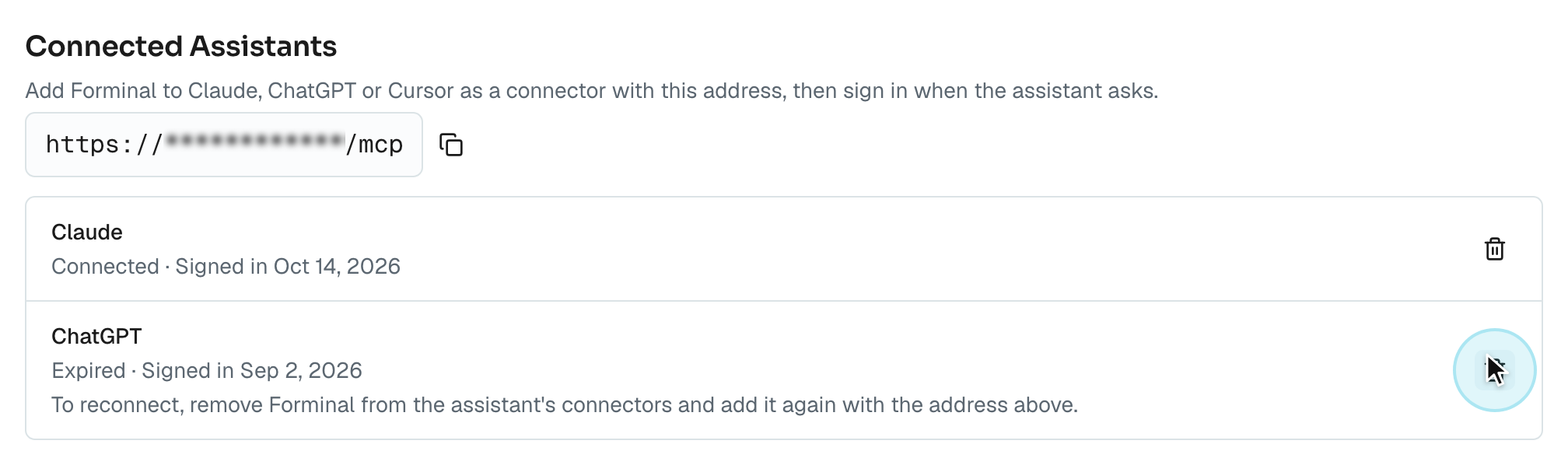
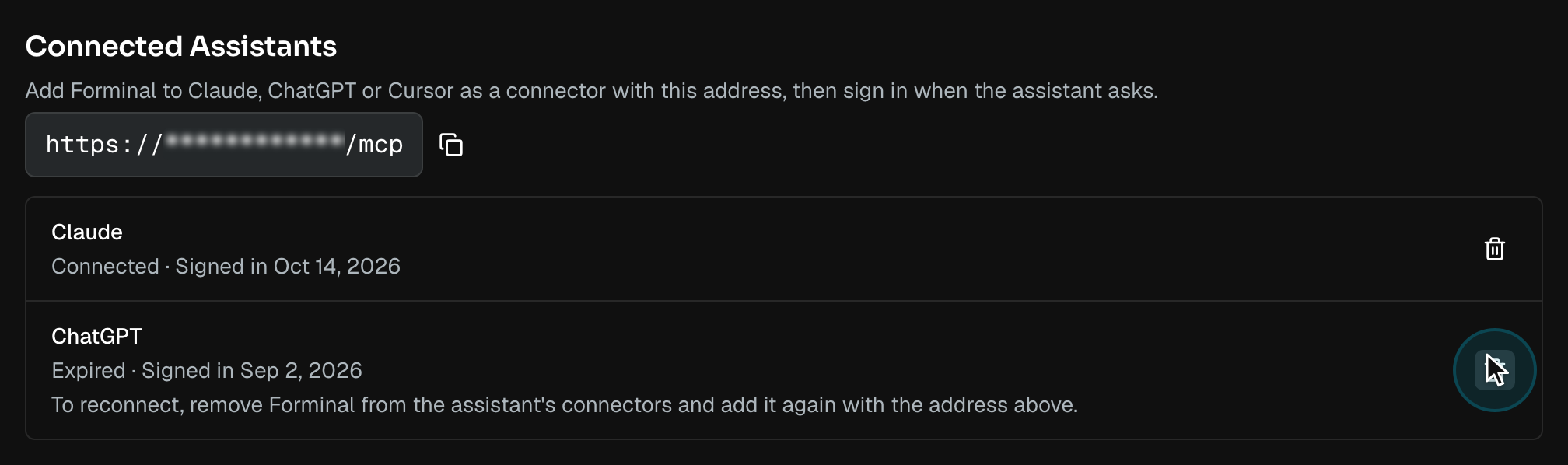
- To cut one off, select Disconnect (the bin) on its row. It goes at once, and the assistant’s next call is refused.
To reconnect an expired one, remove the connector in the assistant and add it again with the same address. In ChatGPT, reconnect Forminal under Plugins on the web. In Claude Code, run /mcp and reconnect, and in Gemini CLI, run /mcp auth forminal. Only the assistant can start a new sign-in, so there’s no reconnect button on this page.
Good to know
The agent works as you, on your plan and your forms, and on any forms others shared with you at the access they gave you. Deleting forms or submissions takes two steps: the agent first gets a summary of what would go and should only delete after you agree. It can delete up to 100 at a time, and nothing brings them back. An export link works for 15 minutes for anyone who has it, and covers up to 20,000 submissions. Editing a published form keeps it published, and the form as it was before each edit is kept as a version you can restore. If you ask for a feature your plan doesn’t include, the change is saved and the agent gets a warning to pass on, saying what the published form does instead and linking to the plans on the pricing page. Each tool also tells your client whether it only reads or changes something, and whether the change deletes or replaces what’s there, so a client such as ChatGPT can ask you before a change.
Frequently asked questions
Which AI clients work with the MCP server?
Any client that connects a remote MCP server over streamable HTTP, with a browser sign-in or an API key. That includes Claude Code, Claude Desktop, claude.ai, ChatGPT, Cursor, Codex CLI, Gemini CLI, VS Code, Kiro and Cline, and they all use the same server address.
Do I have to give the AI agent my sign-in details?
No. You sign in through a browser window, with Google or an email link, and the agent never sees either one.
How do I stop an agent from accessing my forms?
Open Account menu, then Profile, then API keys, and select Disconnect next to the assistant under Connected Assistants. Access ends at once, and its next call is refused.
Can an agent delete my forms or submissions?
Yes, but it takes two steps. The agent first gets a summary of what would go and should only delete after you agree. Nothing brings deleted forms or submissions back.
Can an agent connect without me signing in?
Yes, with an API key from the API keys tab, sent as a Bearer header. That suits scripts or agents that run with nobody there to sign in. See REST API.
What happens if the agent adds a feature my plan doesn’t include?
The agent works on your plan, so the change is saved and the agent gets a warning to pass on, saying what the published form does instead and linking to the plans on the pricing page.
What can ChatGPT deep research find in Forminal?
Forms whose title holds your words, and submissions whose answers or tags hold them. It searches the newest 5,000 submissions on each of your 10 most recently changed forms, skips spam and partial ones, and links every result back to Forminal so ChatGPT can cite it.
Can I watch the agent build my form?
Yes. Sign in, open an empty form, select Build With Your Agent and paste the setup prompt into your agent. Each change it saves shows up in the builder without a reload, until 10 minutes pass with no new change.