Notifications send an email every time someone submits your form. Send one to yourself for each new submission, and another to the person who filled the form in. You write each email yourself and can put answers into its subject and message.
Examples
- An email to you with every answer in a table, sent the moment a lead comes in.
- A “We got your request, @Name” email to the customer, sent to the address they typed into the form.
- An email to your sales team only when the budget answer is over 10,000.
Setting one up
- Open the form in the builder and select Form Settings in the top bar.
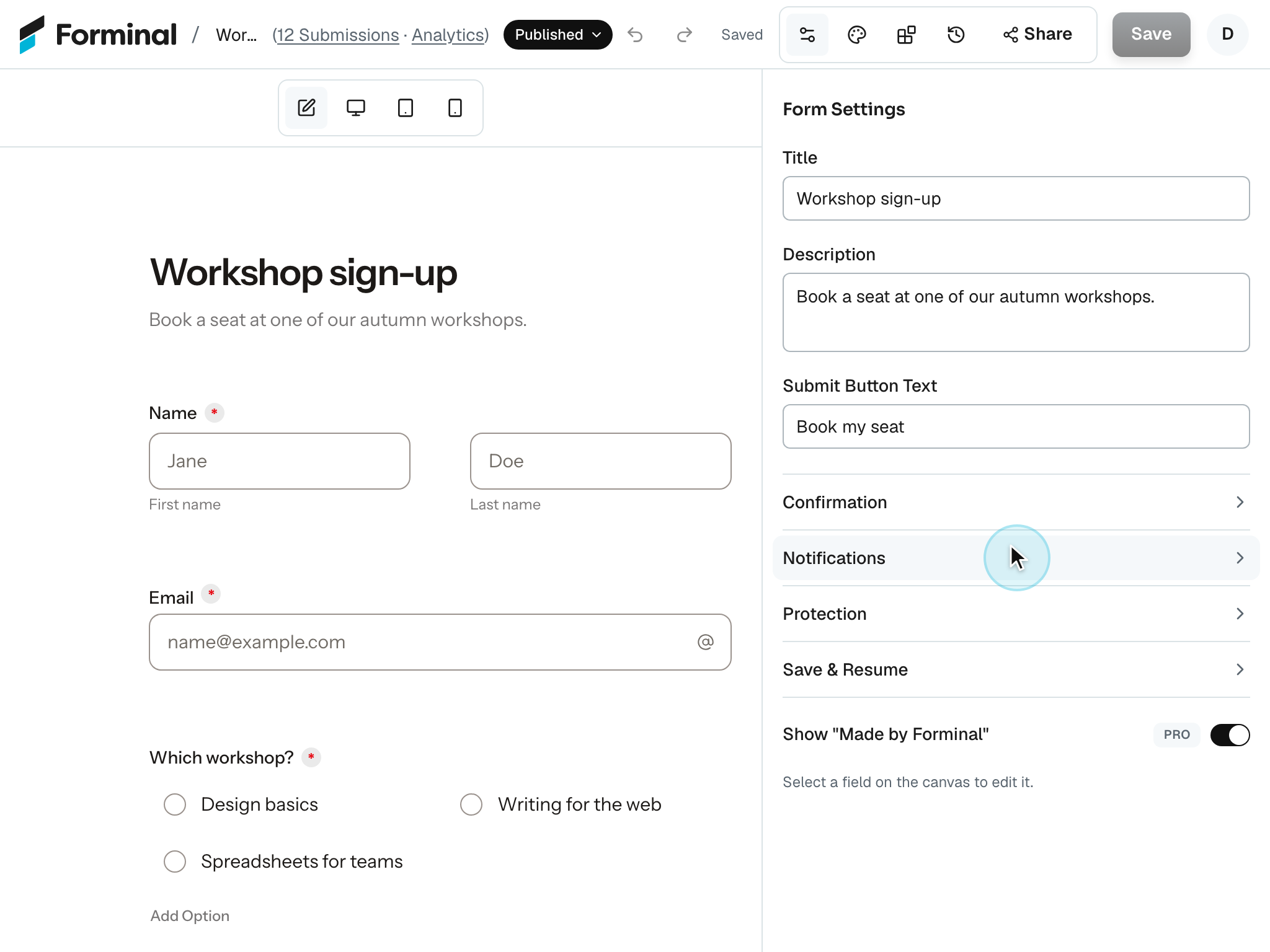
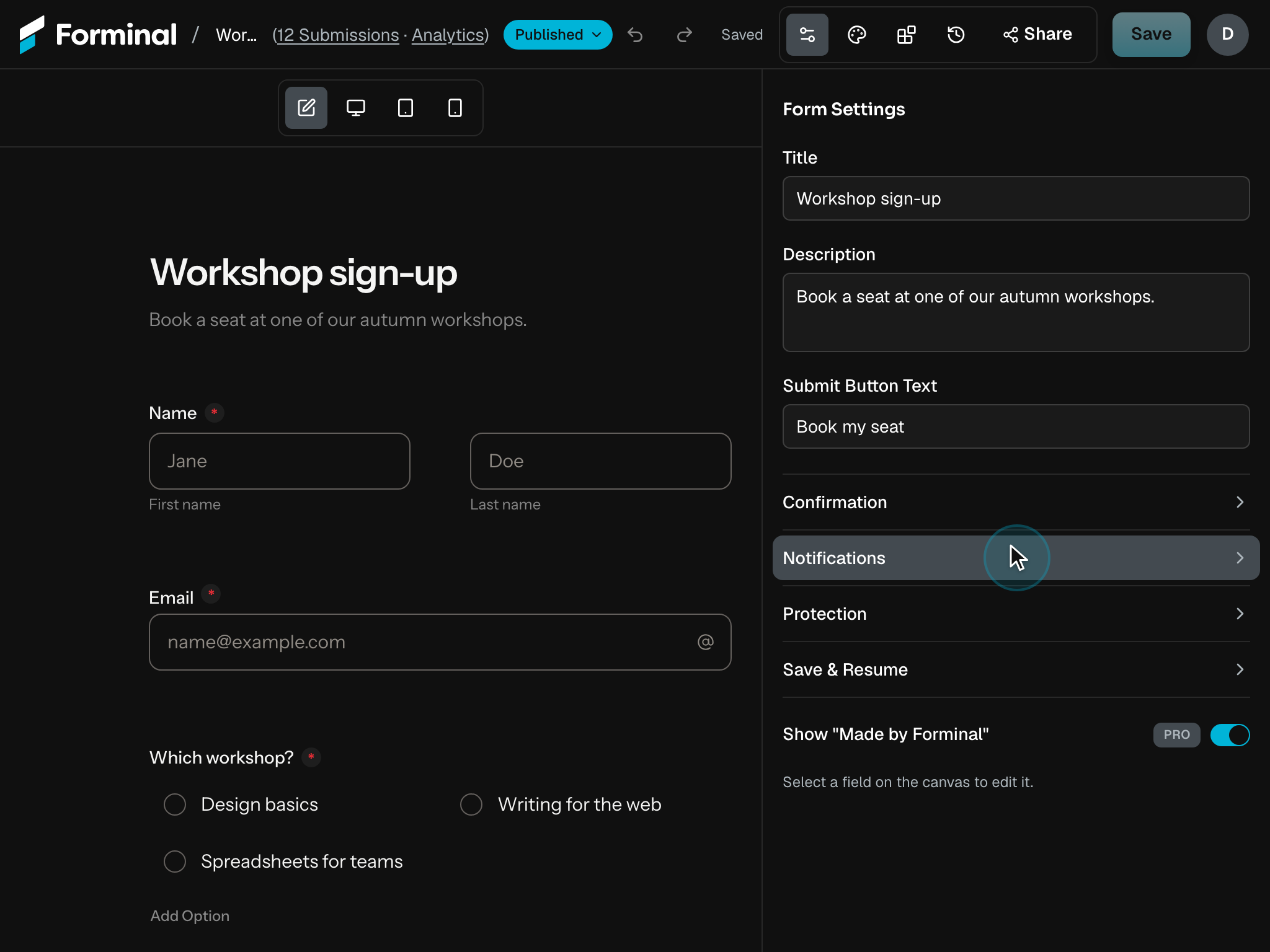
- In Form Settings, select Notifications to see the list.
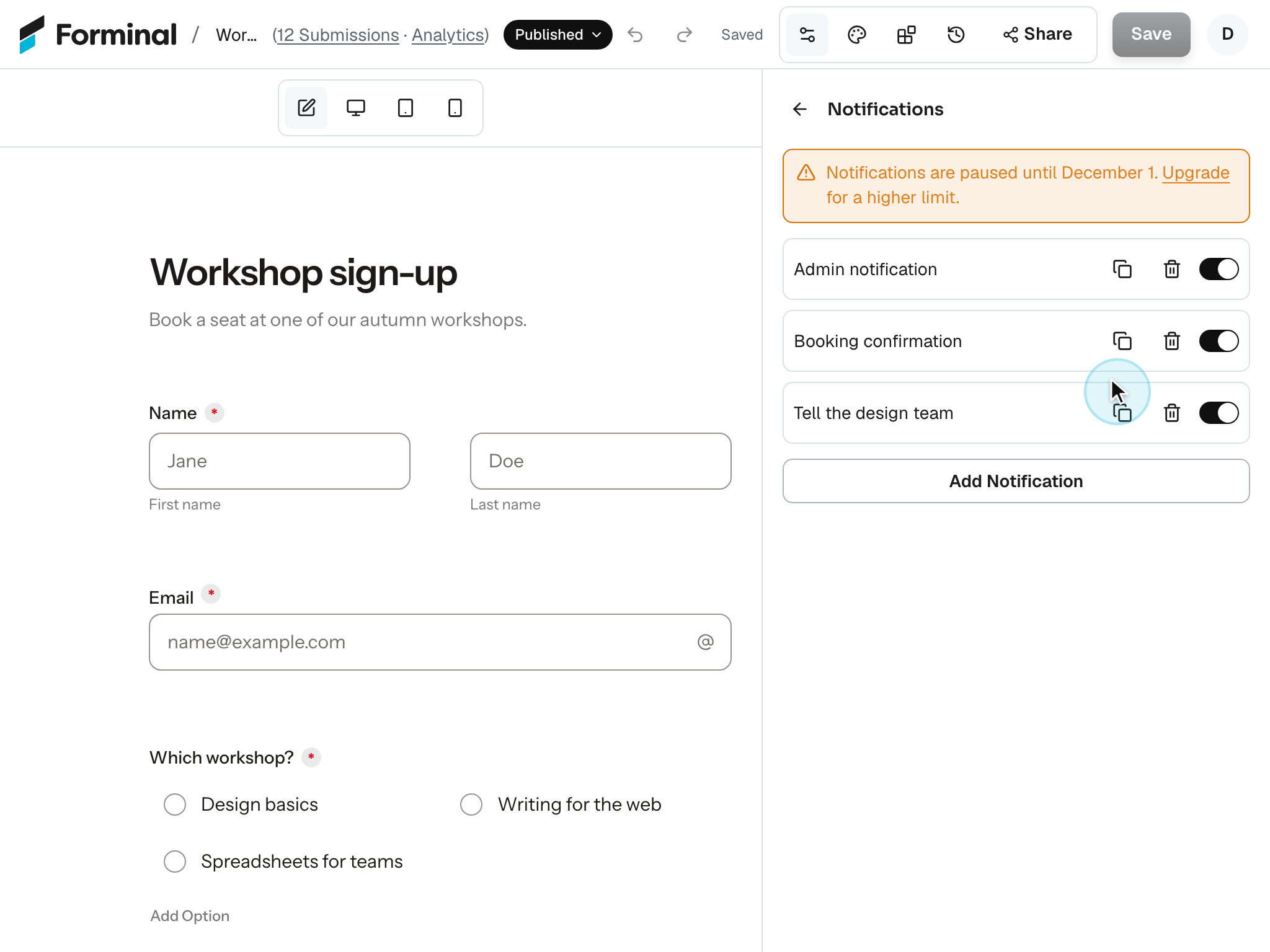
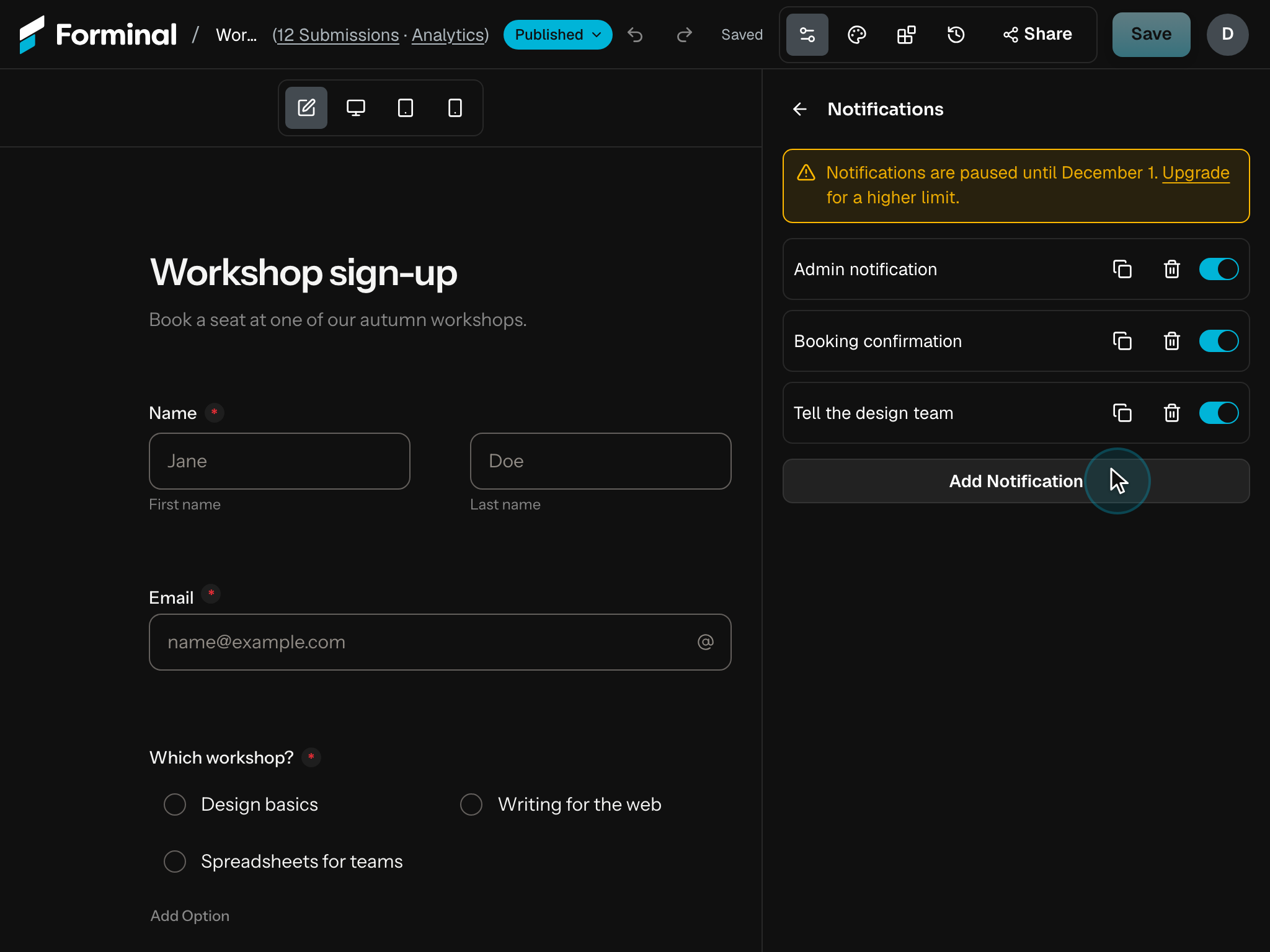
- Select Add Notification, or select a notification’s name to open it. A new one starts out switched on, addressed to you, with the subject “New submission:” and your form’s title, and a message that says “You have a new submission.” followed by every answer.
- Change whatever you need in the email composer: To, Subject and the message.
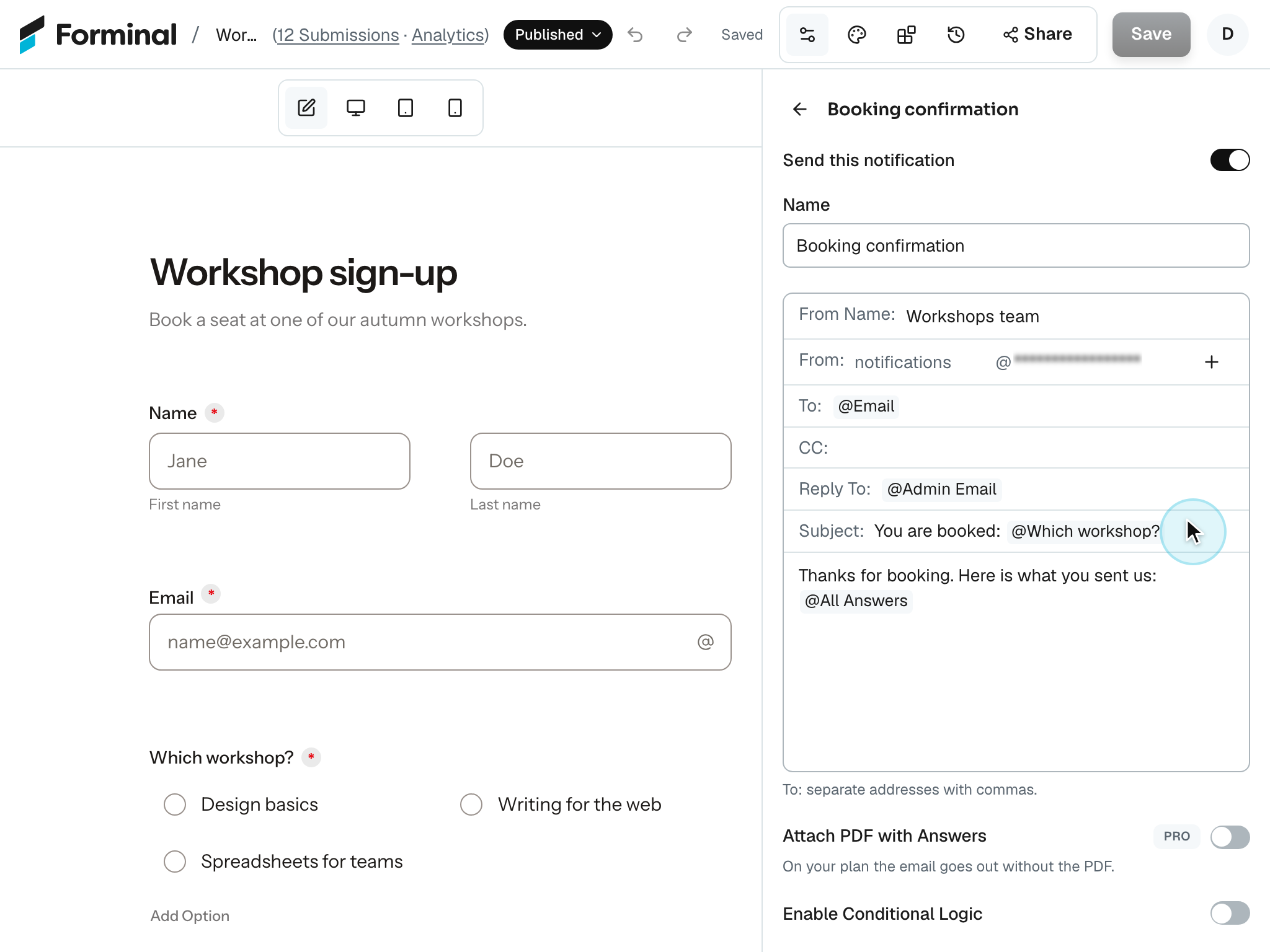
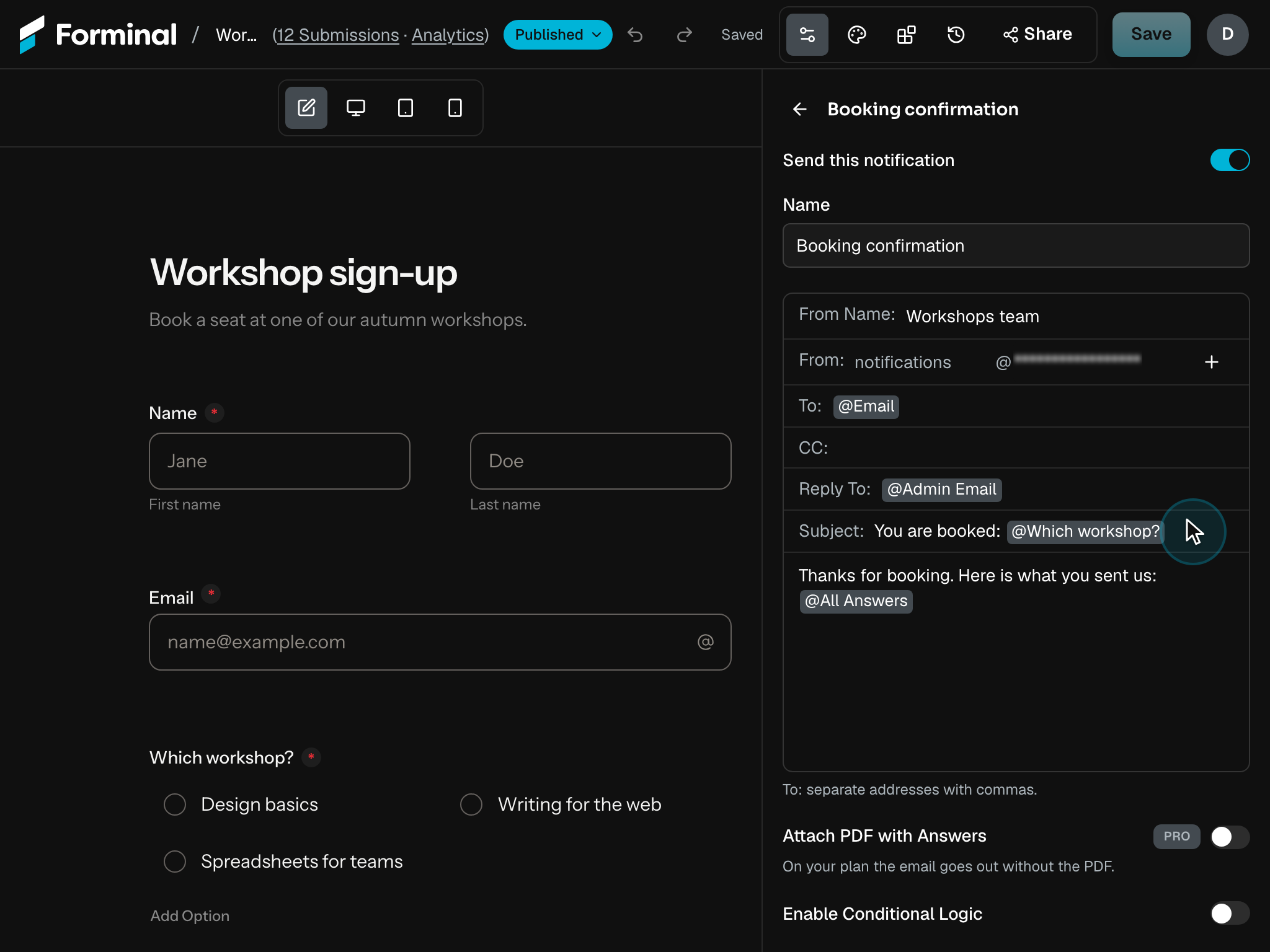
- Select Back to notifications, the arrow at the top of the panel, to return to the list. A new notification shows there with its switch on.
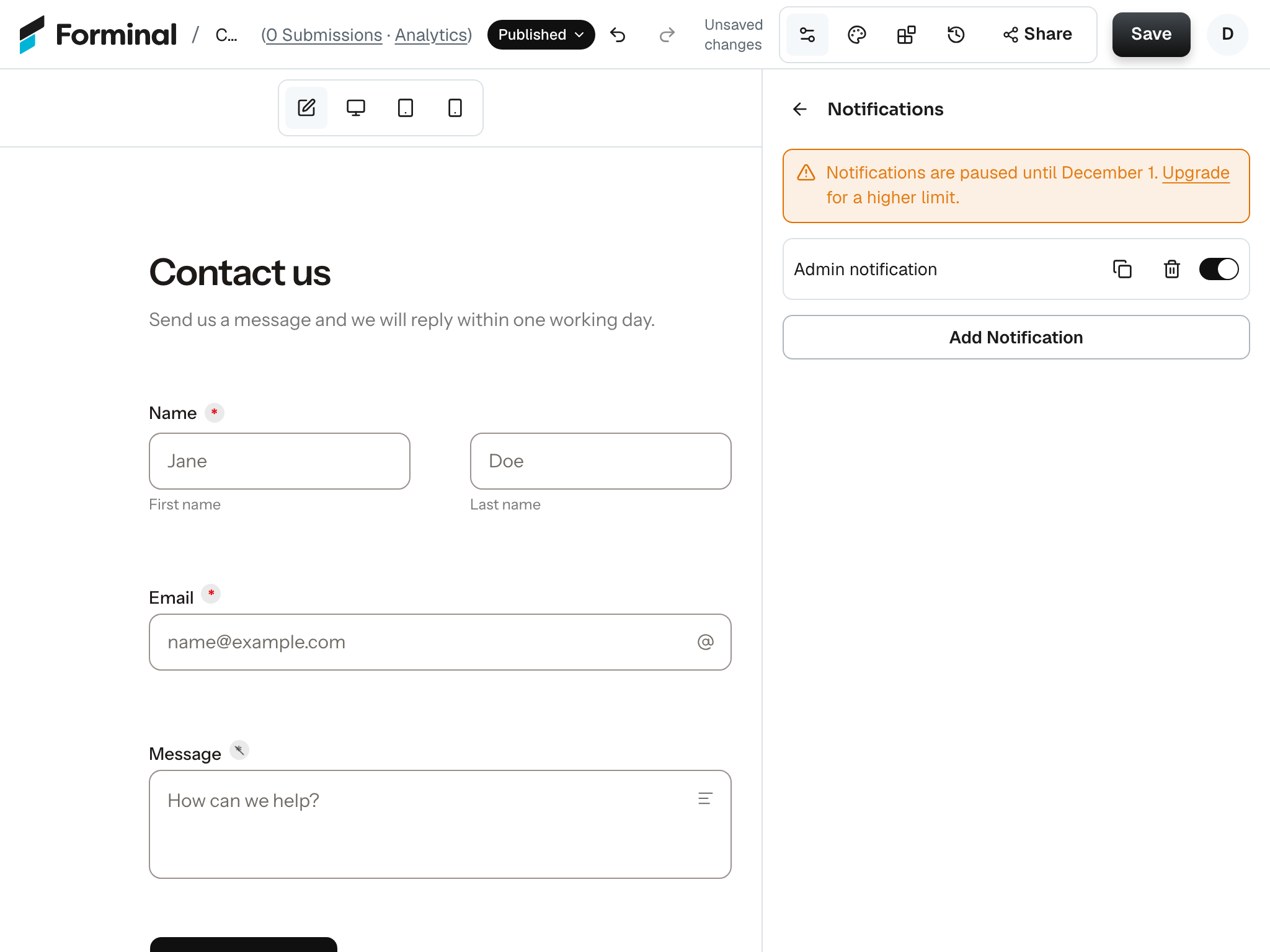
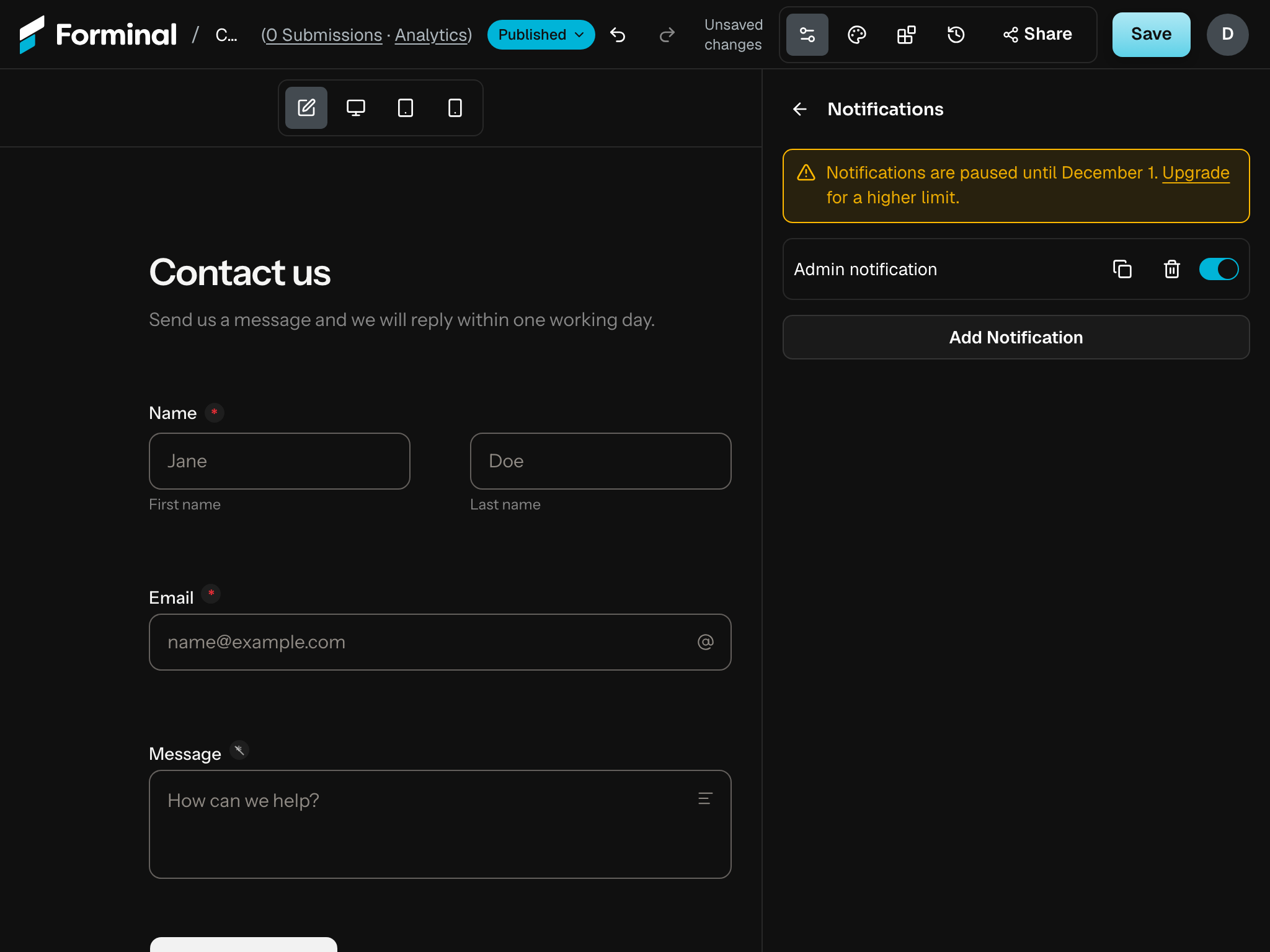
New forms already have one called “Admin notification”, turned off. Switch it on if that’s all you need. In the list, each notification has its own switch, so you can pause one without losing it. The copy icon duplicates one to start a similar email from, and the bin deletes it. Inside a notification, Send this notification is the same switch, and Name is the label you see in the list.
The email composer
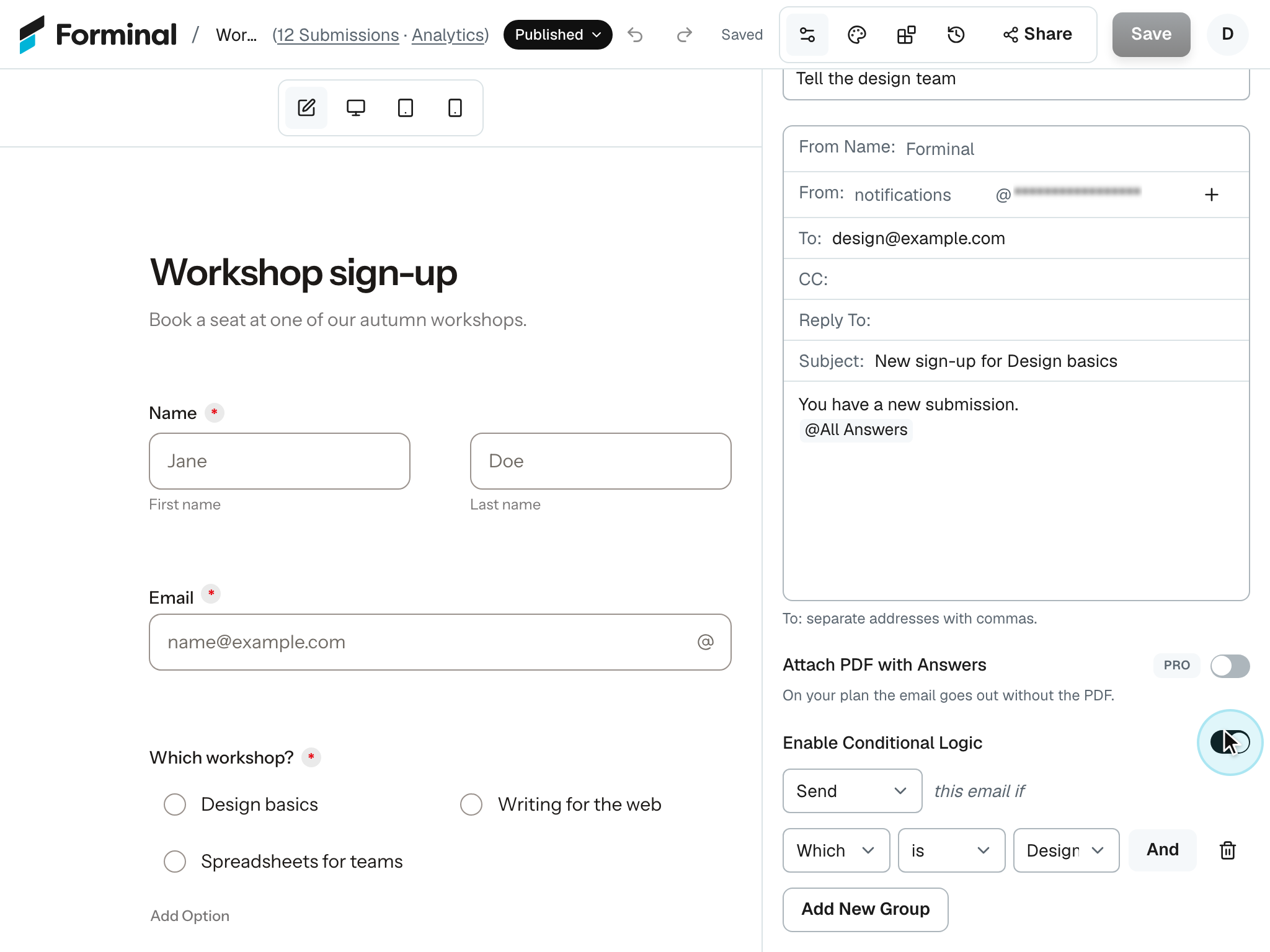
Each notification is laid out like an email: one line for each header, with the message underneath.
- From Name is the sender name people see in their inbox. It’s “Forminal” unless you change it.
- From is the sender address, picked from a list. Every account can send from
[email protected], and that’s the address used unless you choose another. - To and CC take one or more addresses, separated by commas. Type @ to add Admin Email, which is your own account address, or the answer to one of the form’s Email fields.
- Reply To is where replies go. Type @ and pick the respondent’s Email field, and hitting Reply answers them directly.
- Subject is plain text, and you can pipe answers into it with @.
- The message is formatted text with headings, lists, bold, italic and links. Type @ to add an answer, Admin Email, or All Answers to list every question with its answer.
Under the composer, a line points out anything in To, CC or Reply To that isn’t an email address, so you can fix it before anything is sent.
Approve submissions from the email
When the form has a Submission Page set to Approval Required and you’re on the Business plan, type @ in the message and pick Approve Link with the page’s name. Each email then carries a link that opens the new submission’s card with an Approve button, and the submission goes live on the page once someone presses it. The link works for 30 days. It’s sent only when everyone in To, CC and Reply To is you or a workspace member who can publish pages. If anyone else is on the list, the email goes out without the link. Anyone who has the email can use the link without signing in, so don’t forward it.
The All Answers list
Put All Answers on a line of its own and it becomes a table of questions and answers. Put it inside a sentence and each answer reads as “Question: answer”. Questions nobody answered are left out. Uploaded files appear as links to your media library or your Google Drive, and a payment form adds a line with the amount paid.
Sending on conditions
Turn on Enable Conditional Logic, choose Send or Don’t send, and add the rules. “Send this email if the topic is Sales” reaches only your sales team. “Don’t send this email if the country is Canada” skips the cases someone else handles. Rules work the same way as Smart Logic, and a rule you haven’t finished doesn’t stop the email. Conditional logic works on every plan.
When emails go out
Emails are sent once for each submission, after any files are saved. On a payment form, they wait until the payment goes through, so an abandoned checkout sends nothing. Submissions caught as spam and submissions made in preview send no email. If an email can’t be sent, the submission is still saved and the app tries again for about 18 hours.
Good to know
A form can have up to 10 notifications, and each one can go to up to 10 different people across To and CC. Anything past that, and anything that isn’t an email address, is left out. If To ends up empty, for example because the respondent left the Email field blank, that email isn’t sent. Only the first Reply To address is used. A subject can be up to 300 characters, and a Name or From Name up to 100. Messages can’t hold images, and files come as links rather than attachments. The one attachment is a PDF of the answers, which is a Pro feature: see PDF Attachments. There’s no BCC. Notifications work on every plan.
Frequently asked questions
Can I email a copy to the person who filled in the form?
Type @ in To and pick the form’s Email field. If they leave that field blank, the email isn’t sent.
Can uploaded files be attached to the notification email?
Files come as links, not as attachments. A link to a file in your media library opens for someone signed in with access to the form’s submissions, and a link to a Drive file opens in your Drive. The only attachment is a PDF of the answers, which is a Pro feature; see PDF Attachments.
Will I get an email for spam submissions?
No. Submissions caught as spam and test submissions in preview send no email.
Can I BCC someone on a notification?
There’s no BCC. Add people in To or CC instead, up to 10 across both.