Make starts one of your Make scenarios each time someone submits your form. The scenario gets the submission’s answers and details, and from there Make can pass them to any app it connects to. Use it when you want answers to reach a tool that has no direct integration here.
Examples
- Creating a task in a project tool for each request that comes in through a support form.
- Adding new sign-ups to a Mailchimp audience, starting from the Mailchimp template.
Set it up
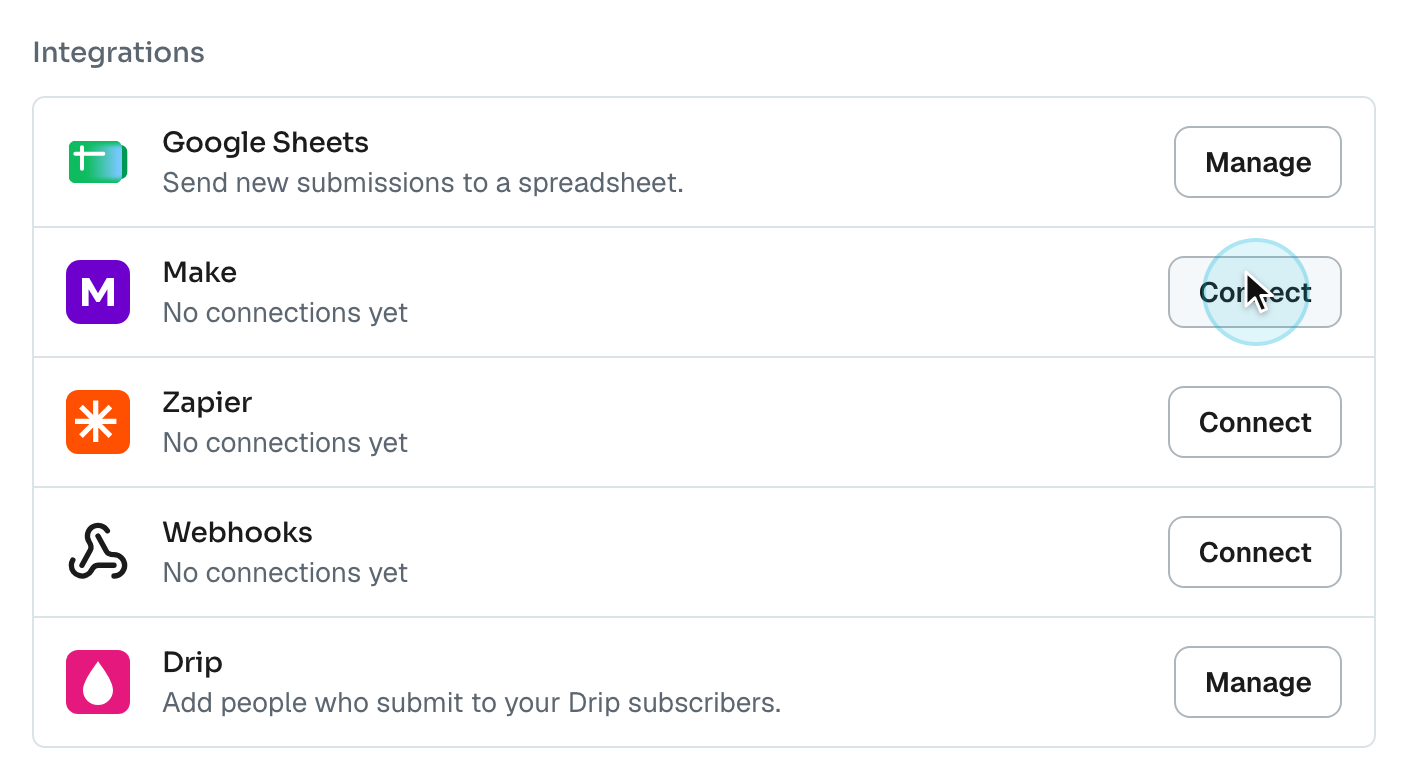
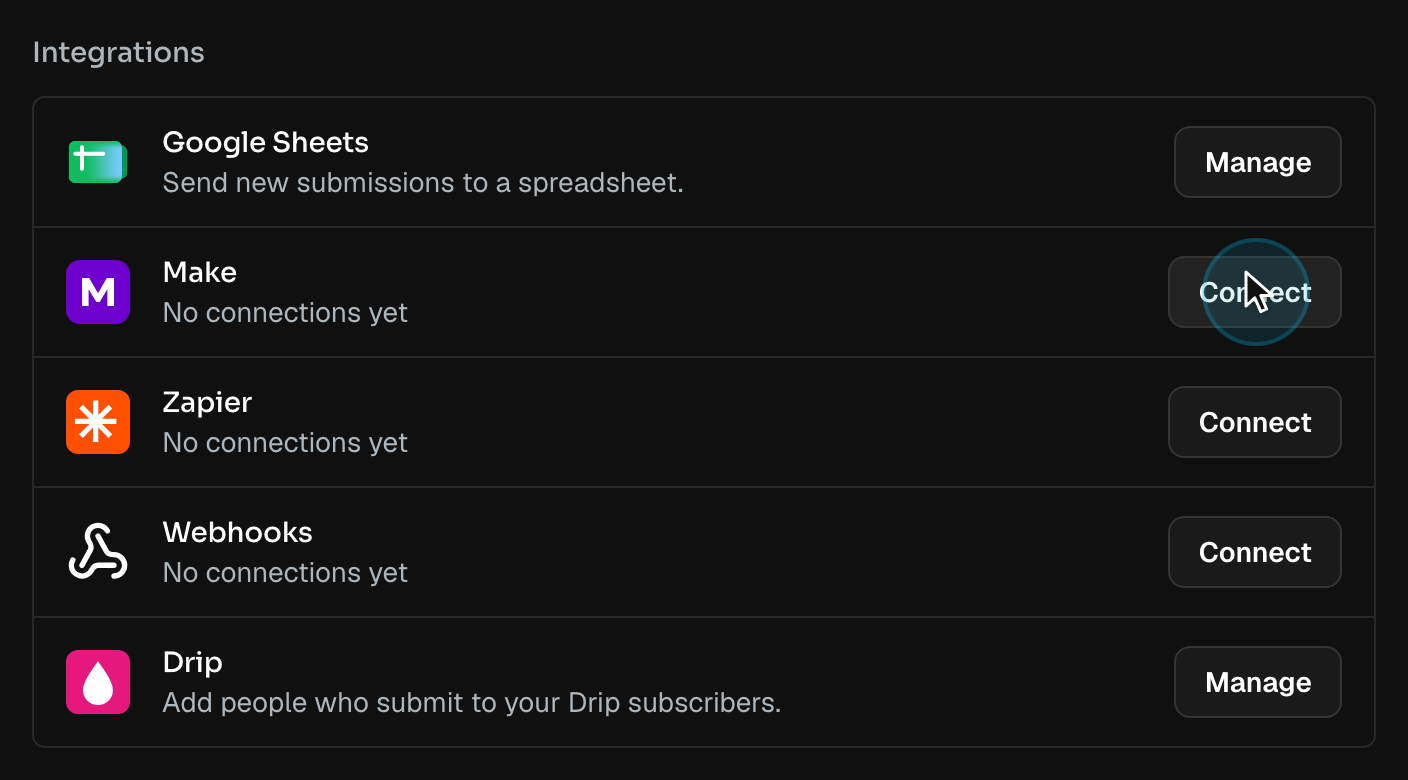
- Open the form in the builder, select Integrations in the top bar, then select Connect next to Make.
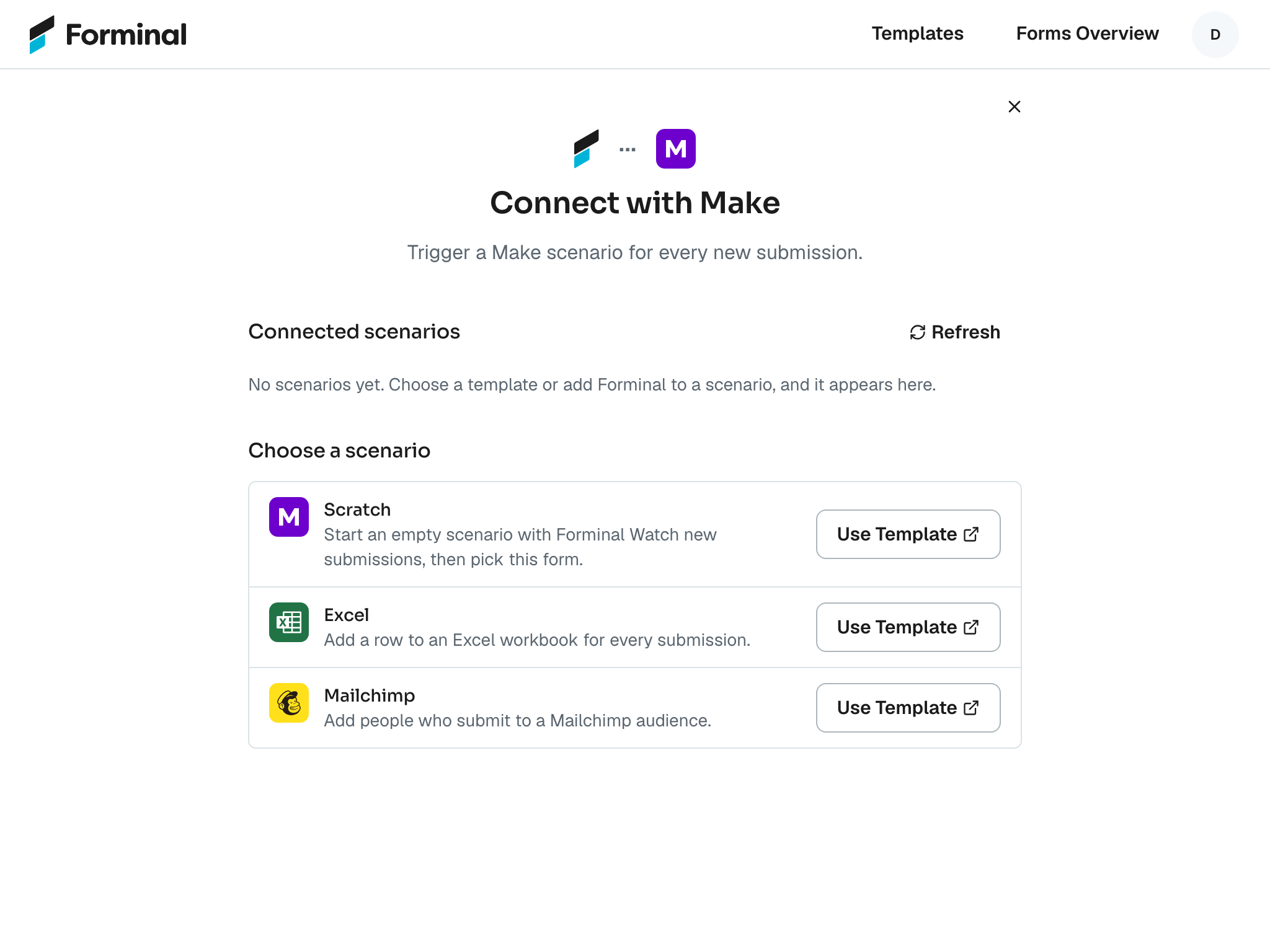
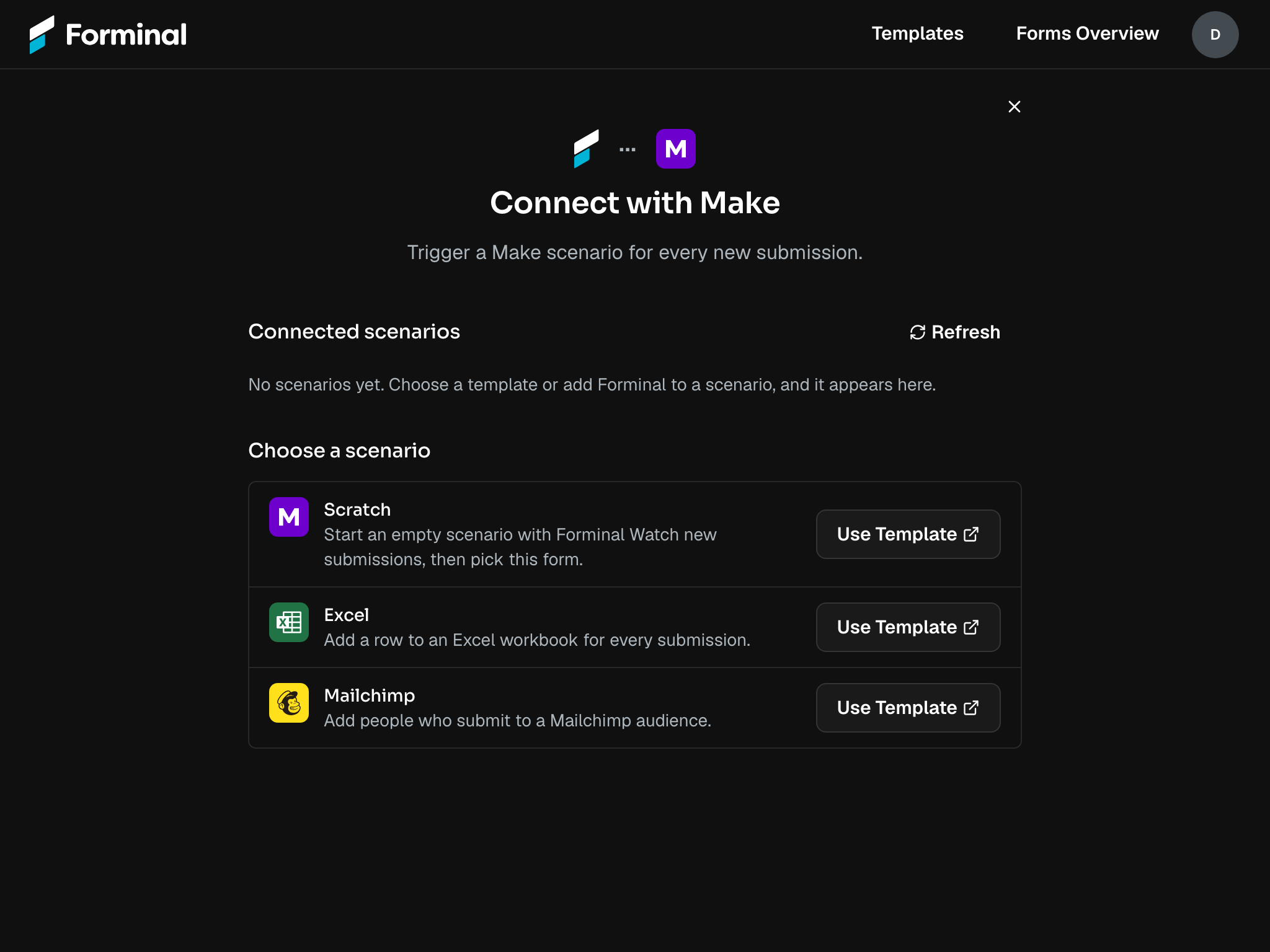
- Under Choose a scenario, select Use Template. Scratch starts an empty scenario with the Forminal Watch New Submissions module. Excel and Mailchimp start a scenario that already adds a row to a workbook or a person to an audience. Make opens in a new tab.
- In the Watch New Submissions module, create a connection to Forminal. Sign in when asked and select Allow.
- Still in the module, select Add to create the trigger. Pick the form under Form, and give it a Name in Forminal, such as “Contact form to Excel”, so you can tell scenarios apart later.
- Select Run once in Make, then go back to the form’s Make page and select Send Test Data. Make now has a sample submission to map fields from.
- Add the rest of your scenario, save it and turn it on.
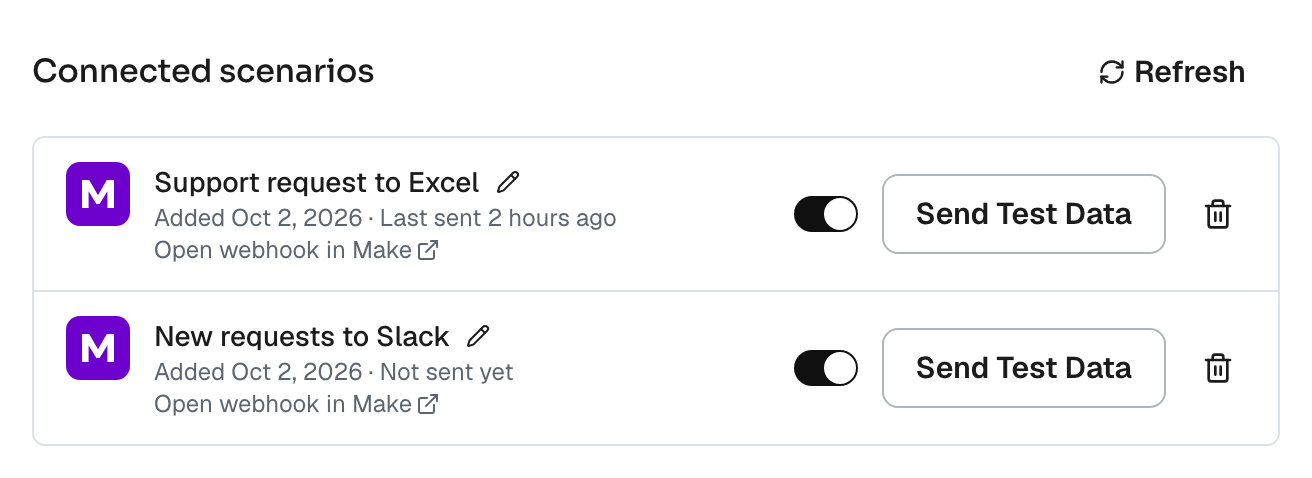
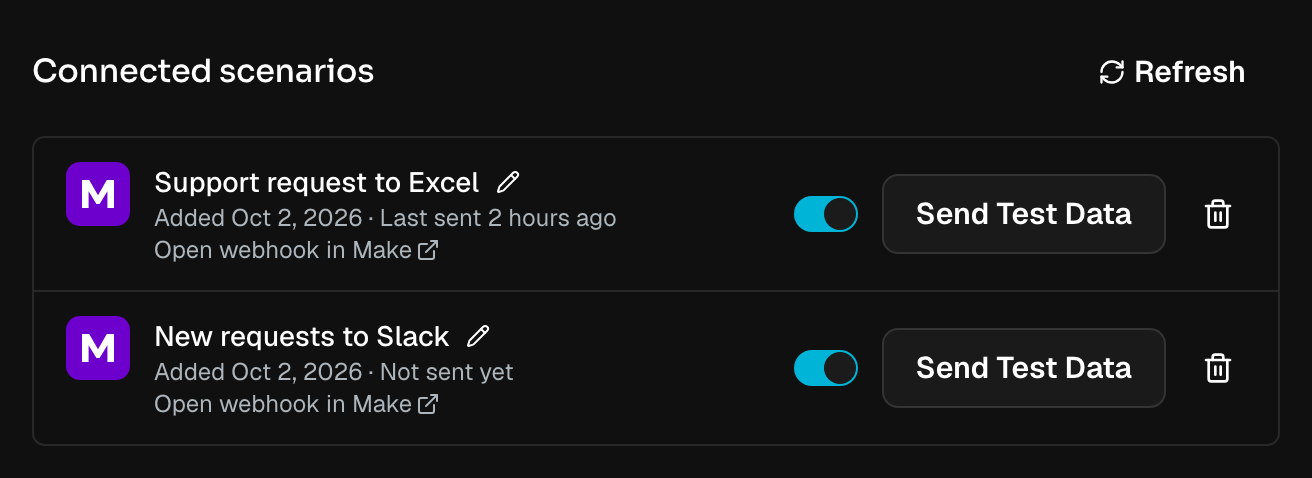
Steps 3 to 6 happen in Make’s scenario editor. The scenario then appears under Connected scenarios on the form’s Make page. Select Refresh if you set it up while the page was open. Each row has a switch to pause it, Send Test Data, a pencil to rename it, a link into Make, the export button (the upload arrow) to export existing submissions, and a bin to delete it. A form can start up to 10 scenarios.
What the scenario receives
Each submission arrives as one bundle with these parts:
- Form: the form’s ID and title.
- Submission: Submission ID, Submitted at, Origin page, Browser, Time to complete (s), Country with its code and name, UTM with UTM Source, UTM Medium, UTM Campaign, UTM Term and UTM Content, Tags, and Payment with its status, amount, currency and mode when the form takes payments.
- Answers: each answer as text, keyed by the question’s label. Two questions with the same label become “Email” and “Email (2)”.
- Answers by field ID: the same text keyed by each field’s ID, which stays the same when you rename a question. Map from this one if you expect to edit labels.
- Fields: a list with each field’s ID, type, label, the answer as text and its raw value.
Answers read the way they do in the submissions table. File uploads and signatures come through as links to the files, in your Google Drive or in your media library. A media library link opens only for someone signed in with access to the form’s submissions, or with an API key. A test bundle has Test set to true and is filled with sample answers, so you can filter it out of a live scenario.
When it runs
The scenario starts right after each submission, once per submission. On a form with a Payment field it waits until the payment is paid. Spam is never sent.
If Make doesn’t answer within 10 seconds, can’t be reached, or answers that it’s busy or has a server problem, the app tries once more a second later. If that also fails, the row on the Make page shows “Could not send the last submission” with the reason, and the app tries again after 1, 5 and 30 minutes, then after 2, 5 and 10 hours. That’s seven tries over about 18 hours, and the message clears once one goes through. In rare cases a retry sends the same submission twice, for example when Make received it but answered too late. Check the submission ID if a repeat matters. When no saved scenario uses the trigger, which happens if you selected Add in Make but never saved the scenario with it, the row says so. Select that trigger in the module and save, or delete the row. If you save the scenario within about 18 hours, the waiting submissions go through.
Send the submissions you already have
The scenario gets the submissions that come in after you connect it. To run it for the ones the form already has, select the export button on the scenario’s row, then Export. The dialog says how many submissions that is. The scenario runs once per submission, oldest first, and uses your Make operations each time. Only complete submissions that aren’t spam are sent, and a submission with a payment only once it’s paid.
They go in the background, after new submissions and at most 50 a minute. The row shows the progress on one line, such as “Exporting · 120 of 400 sent · Stop export”. Select Stop export to drop the ones still waiting. Running it again sends everything again. It won’t start while the row is off or while it’s already exporting.
Disconnect
To stop one scenario, select its bin on the form’s Make page and confirm with Delete. Remove the module in Make too, or the scenario keeps waiting for submissions that won’t come. Deleting the trigger in Make removes the row here on its own. To cut Make off completely, open Account menu » Integrations and select the bin on the Make card. That signs Make out and removes every scenario connection it made.
Good to know
The scenario runs once per submission, so a form that gets 40 submissions runs it 40 times and uses Make operations each time. A paused row sends nothing, and Send Test Data only works while the row is on. You can send up to 20 tests a minute. Turning a scenario off and on in Make doesn’t create a new row here; only creating a new trigger in the module does. Besides Watch New Submissions, the Forminal app in Make has Make an API Call for calling the REST API from a scenario.
Frequently asked questions
Does each submission use Make operations?
The scenario runs once per submission, so a form that gets 40 submissions runs it 40 times and uses Make operations each time.
Will my scenario stop working if I change a question’s label?
Not if you map from Answers by field ID. Those keys stay the same when you rename a question, while Answers is keyed by the label.
What happens if Make is down when someone submits?
Forminal tries once more a second later. If that also fails, the row on the form’s Make page shows Could not send the last submission with the reason, and the app keeps trying for about 18 hours, seven tries in all.
Can a Make scenario do more than watch for new submissions?
Yes. The Forminal app in Make also has Make an API Call, which calls the REST API from a scenario.
Does the scenario run for spam or unpaid submissions?
No. Spam is never sent, and on a form with a Payment field the scenario waits until the payment is paid.
Can I run my scenario for submissions I already have?
Yes. On the form’s Make page, select the export button on the scenario’s row, then Export. Each past submission runs the scenario once, oldest first, and uses Make operations.